Experts to Heroes

Rodney Mullen. Amazing Skateborder, an Expert. I’m always fascinated in his style, innovation and technicality. There is such an excellent spirit and dedication when I see him skate all the time.

This series of videos about him thought me 2 things.

  1. Progress can be due to weird reasons like being tormented by ideas.
  2. When doing something complex, focus on just the key things.

Go check out more of his videos on Youtube.

He will always be my Hero.

Mumbai 2010

Work has brought me to many parts of the world. China in 2004, several places in Europe in 2004, China again in 2005, Italy in 2005, Amsterdam in 2007 and now India in 2010.

I’ve always wanted to go to India. To me its one of the most interesting country in the world. With its diversity, the richness in its culture and the rawness of life.

Mumbai being a busy city with lots and lots and lots of people, the traffic is also very colourful. In Singapore, i hardly hear any honking, but in Mumbai, its like the punctuation in driving. I think on average it was about 5 honks per minute or something like that at least from the cab ride that i took. Also cabs are all super tiny and they zip around so quickly and so closely to one another that alot of them fix bumpers.

The cab that i was in actually hit a truck from behind. The driver got out, waved, and everything was good. Cool.

My colleagues fed me ALL SORTS of Indian food. I seriously can’t remember all the names of the food, but “Indian Chinese” would have to be something easy for me to remember.

On this trip, there was some time for me to timeout and i made good use of the TOTO tub. Overall the room in four seasons was wonderful, very comfortable. But the bed was so soft that i sank in. Kinda not use to that.

Just outside my room window, was Mumbai. The zinc roofs, the slums, the reality.

We went up to AER lounge and chilled. Had a Mojito and some Pitas with Indian condiments.

The sun set into the smog and i’m reminded that no matter where i am in the world, we all share the same sun and that there is no such thing as one life being better than the other.

Dear India, i’ll be back.

Spelling

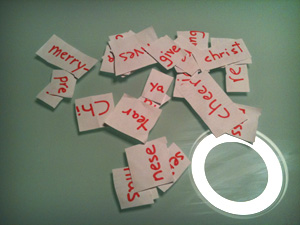
For those with kids, you will know the challenge of teaching your kid spelling EVERY WEEK!

Clié has a super short attention span and something like spelling is in no way fun. So i thought we could have fun doing a jig saw puzzle version of her spelling list.

It worked!! She enjoys it. I wonder how many weeks can this last.

CSS Normalisation

If you don’t plan, you plan to fail.

Developers all know the importance of Data Normalisation and its a key planning activity to ensure data integrity, optimal data warehousing by reducing data redundancy, ease of extending database structure, etc. I really feel web designers need to understand the spirit behind normalisation when planning their designs as well.

A website have many elements, from headers to footers, navigation to utility bars, from page wrappers to content containers. And from within the content container itself there are loads of normal HTML elements such as headings, paragraphs, tabular content, lists, forms, quotes, indents and the list goes on.

So just understanding and using CSS is not enough as a large site needs alot more planning. I feel that having a planning session to determine what ID and CLASS to assign to elements is extremely important. Also keeping in mind that using Content Management Systems mean webmasters (your clients) are most likely going to use something like CKEditor or TinyMCE as their WYSIWYG editor which by default uses the basic HTML tags.

So planing for CSS Styles is actually a CSS Normalisation process in my view. Data Normalisation is about “data relationships” and for CSS its about “cascading styles“. Styles are related by inheritance and these inheritance are the relationship.

Data Normalisation Objectives according to databasedev.co.uk:

  1. Arranging data into logical groups such that each group describes a small part of the whole
  2. Minimizing the amount of duplicated data stored in a database
  3. Building a database in which you can access and manipulate the data quickly and efficiently without compromising the integrity of the data storage
  4. Organising the data such that, when you modify it, you make the changes in only one place

So let me try to translate these objectives into CSS Normalisation objectives.

CSS Normalisation Objectives

  1. Arranging CSS Styles into logical groups such that each group describes a small part of the whole
  2. Minimizing the amount of duplicated CSS Styles stored in the CSS file(s)
  3. Building the CSS file(s) in which you can access and edit the CSS Styles quickly and efficiently without compromising the integrity of the whole website
  4. Organising the CSS Styles such that, when you modify it, you make the changes in only one place

Agree? Disagree? Do share your views.

ps: If only someone can do up a simple diagram like Natalie Josy’s Standards in a nutshell to visually explain this CSS Normalisation concept, i’ll definitely stick it to this post.