Eleanor Roosevelt famously said, “Great minds discuss ideas; average minds discuss events; small minds discuss people.“ While the quote captures a powerful truth, I feel human communication is slightly more nuanced than that and not to forget everyone also likes to talk about themselves.
In everyday life, our conversations generally fall into four distinct levels. Starting from the most self-centered to the most elevated, these levels define not just what we say, but how we think, what is important to us and shows others who we are. But I think its not so simple as each level carries both a positive and a negative angle, meaning how you talk at any level matters just as much as what you talk about.
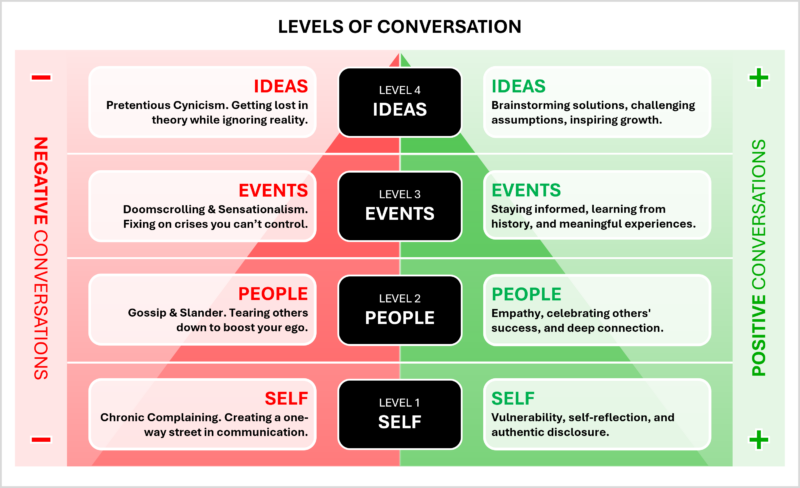
Level 1: Talking About Self
This is our default setting and it applies to all of us. It is natural for everyone to talk about themselves, their feelings, wants, achievements, and grievances. Its a way we update others on what’s going on with our lives.
- The Positive Angle (Authentic Self-Disclosure): Expressing genuine vulnerability, sharing personal struggles, and practicing self-reflection. When done with humility, talking about oneself fosters deep human connection and trust.
- The Negative Angle (Self-Obsession): Constant boasting, egoistic, complaining, or turning every conversation back to “me.” It creates one-sided interactions that leave others feeling unheard and drained.
Level 2: Talking About People
Moving one step beyond the ego, Level 2 focuses on other individuals and social relationships.
- The Positive Angle (Empathy & Appreciation): Celebrating someone else’s success, studying admirable role models, expressing gratitude, and seeking to understand others’ perspectives.
- The Negative Angle (Gossip & Slander): Spreading rumors, tearing down reputations, judging others behind their backs, and toxic comparison. This builds an environment of paranoia. You know what… if someone gossips with you, they will likely gossip about you.
Level 3: Talking About Events
At this stage, conversations shift away from individuals and toward happenings in the world around them, news, sports, politics, travel, and historical milestones.
- The Positive Angle (Curiosity & Context): Analyzing world events critically, understanding culture, learning from history, and planning meaningful experiences. It helps us navigate the environment around us.
- The Negative Angle (Doom scrolling & Sensationalism): Fixating exclusively on crises, outrage, surface-level drama, and things outside your control without seeking solutions. It fuels anxiety and helplessness.
Level 4: Talking About Ideas & Concepts
The highest level of discourse, and the rarest and is centered on abstract concepts, philosophy, innovation, system design, values, and future possibilities.
- The Positive Angle (Creation & Problem-Solving): Brainstorming solutions to systemic problems, exploring vision and purpose, challenging assumptions, imagining a better future, and inspiring collective growth.
- The Negative Angle (Pretentious Cynicism & Dogma): Using intellectual jargon to look superior, debating purely to win rather than learn, or getting lost in detached theories while ignoring real-world application.
Navigating the 4 Levels in Daily Life
No one spends 100% of their time at one level. For example, it would be exhausting to debate philosophy over breakfast or analyze global economics while picking up groceries. Healthy human connection requires balance:
- Use Levels 1 and 2 for Bond Building: Warmth and intimacy are built on sharing personal updates (Level 1) and caring about people (Level 2).
- Use Level 3 for Engagement: Staying informed about world events keeps us grounded in reality and connected to community.
- Aim for Level 4 for Growth: Ideas drive innovation, self-actualization, and long-term transformation.
The key is intentionality. Notice where your conversations drift today. Are you stuck in the negative traps of gossip and self-centered complaining? Or are you using your words to uplift others, understand the world, and build better ideas?
Let’s be more intentional in our conversations to build healthy relationships with others and with ourselves.