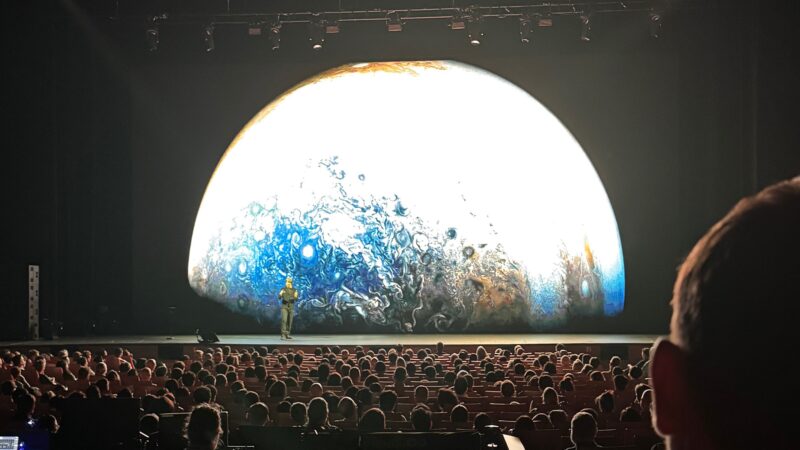
Recently I attended a lecture in Singapore by Professor Brian Cox: Emergence, his brand new world tour for 2026. Lots of really nice scientific theories explained in visually arresting ways and in such simple terms. It then inspired me to put down some of my own thoughts in this area. So here goes…
We usually think of time as a universal clock ticking away at the exact same speed for everyone. In reality, time is personal and elastic. It is a dimension just like up/down, left/right, and forward/backward that allows events to happen in a sequence. The mind-bending thing is that it passes at different rates depending on how fast you are moving and how much gravity is pulling on you.
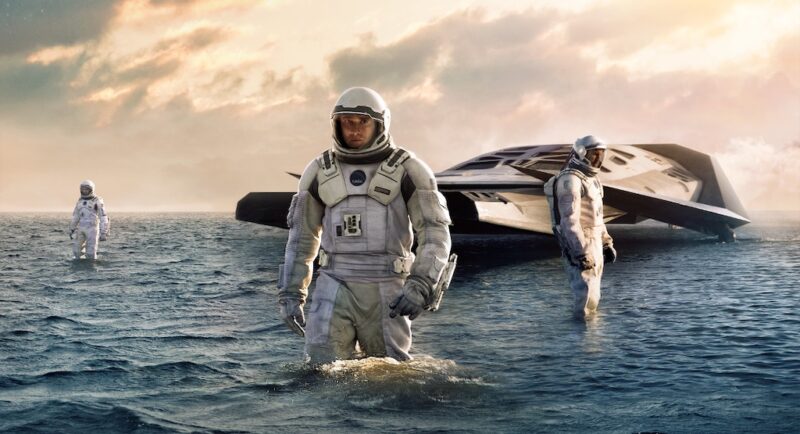
Remenber that Miller’s Planet scene in Interstellar? A few hours passed on the planet for the team that went down to the planet, but years for the space craft orbiting it. Then I though to myself is there a way to visualise how speed and gravity affects time in one chart. Of course with the help of AI, this chart is easily generated and thats what I did this weekend and its beautiful.
Two concepts we first need to understand.
- Special Relativity – Einstein’s first big breakthrough was realizing that the speed of light is the absolute speed limit of the universe, and it never changes. Because the speed of light is constant, space and time have to bend to accommodate it. So if you travel on a spaceship near the speed of light, time actually slows down for you compared to someone standing still on Earth. This is time dilation.
- General Relativity – A few years later, Einstein realized that space and time are stitched together into a single fabric called spacetime. Gravity isn’t a mysterious invisible pulling force; it’s the result of heavy objects bending that fabric. Imagine putting a heavy bowling ball on a trampoline. It creates a dip. If you roll a marble nearby, it spirals toward the bowling ball. That “dip” is gravity. Earth’s gravity curves the spacetime around it, which is what keeps our feet on the ground.
So putting these 2 concepts together, I generated this Time Dilation Map which shows how Speed and Gravity together affects time.
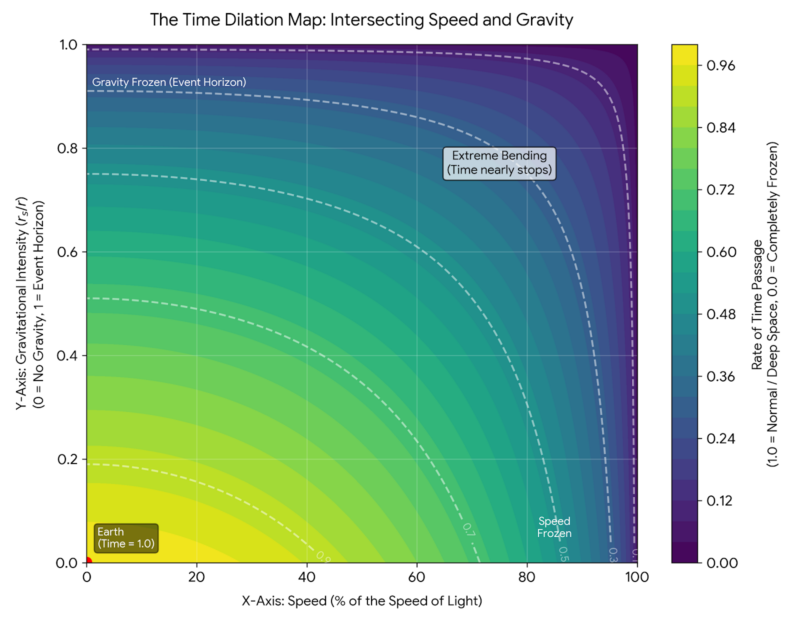
How to Read This Map:
- The Color Scale (Z-Axis): The colors indicate the Rate of Time Passage.
- Bright yellow areas “1” mean time is ticking at its normal, maximum speed.
- Deep purple/blue areas “0” mean time has completely stopped relative to the rest of the universe.
- The White Dashed Contour Lines: These act like elevation lines on a map, showing you exactly where time slows down to 90%, 70%, 50%, 30% and 10% of its normal rate.
The 4 Corners of the Universe on this Chart:
- The Bottom-Left Corner (Earth / Normal Life): This is where humans live. Our speed is practically 0% of the speed of light, and Earth’s gravity is incredibly weak compared to a black hole. Time here passes at a perfect “1” where we experience normal life. (While we know our solar system is zipping through space so we are not totally at no speed, but let’s keep it simple for now.)
- The Bottom-Right Corner (The Speed Zone): If you travel at 99% the speed of light out in empty space (far away from any stars or gravity), you drag your position horizontally all the way to the right. As you can see, the color plummets into the dark purple zone. Time almost freezes because of your velocity.
- The Top-Left Corner (The Gravity Zone): If you park your spaceship completely still, but right at the Event Horizon of a black hole “1” on the Y-axis, you move straight up the chart. Time freezes here entirely as well because of the immense gravity warping spacetime.
- The Top-Right Corner (The Ultimate Extreme): This is the realm where a traveler is both moving near the speed of light and falling into a black hole. Here, both variables compound to crush the passage of time down to absolute zero well before you even hit the maximum edge.
By treating speed and gravity as coordinates, an advanced interstellar traveler could use this exact map to calculate exactly how much they want to step into the future of the universe!
In fact, we have to calculate both of these variables right now for our GPS satellites! Because they are moving fast around the Earth, their clocks slow down. But because they are further away from Earth’s gravity, their clocks speed up. Scientists have to constantly correct for both variables, or your phone’s GPS would drift by miles every single day.
Very interesting things to think about.