Failures Are Data, Not Fate: Why Curiosity Will Save Humanity

Photo by Ian Taylor on Unsplash

There is a natural human tendency, when faced with tragedy or the unknown, to look for a narrative.

When a natural disaster strikes, when an economic crisis hits, or when an individual faces a devastating mistake or unfortunate incident, we instinctively try to categorize it. We label events as “bad luck.” We chalk misfortunes up to “fate,” the “will of God,” or in some cases “evil” or “spiritual warfare”. We write off what we don’t understand as spiritual mystery, and in doing so, we unwittingly surrender our agency. We stop asking how and why, and instead settle for it-is-what-it-is.

For thousands of years, this was a survival mechanism. It gave us comfort in a world where we had very little control over our environment.

But if the story of human civilization has taught us anything, from the way natural selection shapes life to the way we learn, innovate, and build, it’s that we are not passive passengers in this universe. The ones that progress survives and maybe even thrive, those that don’t gets left behind and eventually fade away.

We need to stop dwelling in our failures or hiding behind supernatural explanations, and instead double down on our greatest superpower: relentless, cooperative curiosity.

Failure Isn’t a Judgement, It’s Feedback

When an engineer tests a rocket and it explodes on the pad, they don’t call it “spiritual warfare”. They don’t throw their hands up and claim the laws of physics were cursing them or that it was not a good day according to the Tong Shu Almanac or that the Feng Shui of the pad was wrong or that it was clearly inauspicious to launch rockets.
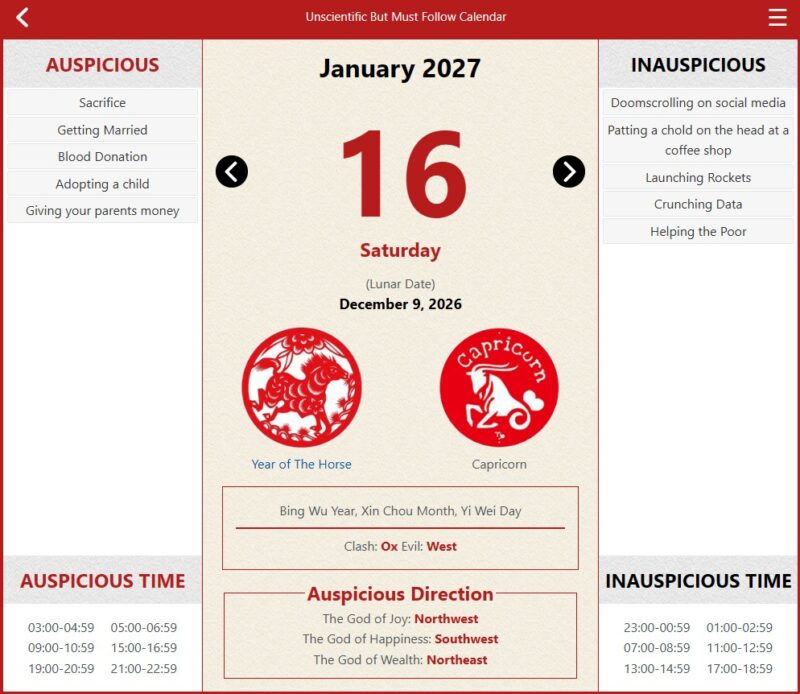
An illustration of a typical Chinese Tong Shu Alamac many superstitious people still follow in this day and age.

They don’t do all that and their bosses will not give them any budget to do that. Instead, they examine the telemetry. They look at the data. They isolate the valve that failed, redesign it, and build a better system.

In science and engineering, a failure isn’t a moral judgment, it’s data. It’s the universe telling us, “That specific approach didn’t work. Try again with another variable.”

Yet, as a society, we rarely treat human mistakes or natural disasters with that same analytical grace. When geopolitical conflicts flare, when economic systems buckle, or when personal failures occur, we dwell in blame, shame, and ideological division.

If we applied the scientific method to our societal problems, viewing failures as mere feedback loops rather than fatal flaws, everything would change. Unfortunate disasters, whether natural or man-made, shouldn’t be accepted as inevitable suffering. They are invitations to figure out how to prevent them, adapt, and come out stronger on the other side.

The next 12 months, we are expecting the 2027 super El Nino, its either we make preparations and study how to prevent future occurrence or we can just say the Gods must be angry with humans and that we need to give a sacrifice to Zeus, the supreme deity of the Greek pantheon, the sky and thunder God who rules as king of the Gods on Mount Olympus, child of Cronus and Rhea. Sounds funny you say? But those were the beliefs of the wisest humans back in the day. Maybe in a few hundred years, our descendants will look at us with a similar unbelief that we actually use something like the Tong Shu to direct our lives.

Replacing Mystery with Science and Collaboration

Writing off the unknown as a spiritual mystery might feel comforting, but it halts progress. Every major breakthrough in human history, from eradicating diseases to harnessing electricity happened because someone refused to accept the unknown as unknowable. They were curious enough to seek the truth through observation, evidence, and science.

The Giant Arc is a claimed large scale structure bigger that the known universe discovered by the team of Alexia M Lopez, then a doctoral candidate, now a post-doctoral researcher in cosmology at the University of Central Lancashire. Image from Wikipedia.

Imagine what happens when we scale that curiosity across the entire human race.

Right now, so much of our global energy is fragmented. We fight over artificially scarce resources, build walls around our intellectual property, and trap ourselves in zero-sum geopolitical games.

If we redirected even a fraction of that energy, that human capability toward solving fundamental problems as one unified human race, the progress wouldn’t just be linear—it would be exponential.

  • Scarcity is a solved problem waiting for better execution. We have the fundamental physics and intelligence to unlock clean, abundant energy (fusion, advanced solar, next-gen grids) and feed every human on Earth through automated agriculture and biotechnology.
  • Societal division is an alignment problem. Most geopolitical friction stems from competition over resources and fear of the unknown. When we solve energy, health, and education, the root causes of major conflicts begin to dissolve.

A World Beyond the Capitalistic Grind

Why does all of this matter? Why push for exponential progress?

It’s not just about building sleeker tech or living longer. It’s about liberating human potential.

In our current capitalistic framework, millions, if not billions of brilliant human minds spend their waking hours stuck in survival mode. They work jobs they don’t love, driven by the individual economic pressure to afford food, shelter, and healthcare. Imagine the potential scientific theories, art, literature, and inventions we lose every day simply because people don’t have the space to pursue their passions.

When we use science, technology, and collective cooperation to eliminate scarcity, we dismantle that survival pressure. We unlock a world where people can spend their waking hours embracing their true curiosities. Where you choose how you want to contribute to society and not because a paycheck dictates it, but because you are genuinely excited to help solve a puzzle, solve a worthy problem, create art, or push the boundaries of human knowledge.

Moving Forward as One Race

Progress isn’t guaranteed, and it doesn’t happen by accident. It is a conscious choice.

We can choose to remain divided, labeling our setbacks as “bad luck” or “fate,” and letting fear dictate our future. Or we can choose to be curious. We can choose to embrace failure as the price of iteration, look at disaster as a challenge to engineering better systems, and view every human on this planet as a teammate rather than a competitor.

The universe is vast, complex, and full of unsolved mysteries. Let’s pool our resources together and let’s start picking a few and solving them together.
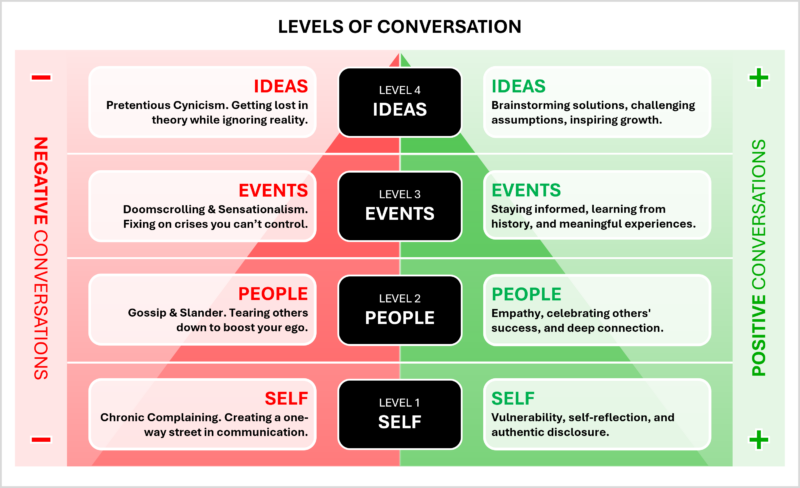
Levels of Conversation: How Your Conversations Shape Your Life

Eleanor Roosevelt famously said, Great minds discuss ideas; average minds discuss events; small minds discuss people. While the quote captures a powerful truth, I feel human communication is slightly more nuanced than that and not to forget everyone also likes to talk about themselves.

In everyday life, our conversations generally fall into four distinct levels. Starting from the most self-centered to the most elevated, these levels define not just what we say, but how we think, what is important to us and shows others who we are. But I think its not so simple as each level carries both a positive and a negative angle, meaning how you talk at any level matters just as much as what you talk about.

Levels of Conversation

Level 1: Talking About Self

This is our default setting and it applies to all of us. It is natural for everyone to talk about themselves, their feelings, wants, achievements, and grievances. Its a way we update others on what’s going on with our lives.

  • The Positive Angle (Authentic Self-Disclosure): Expressing genuine vulnerability, sharing personal struggles, and practicing self-reflection. When done with humility, talking about oneself fosters deep human connection and trust.
  • The Negative Angle (Self-Obsession): Constant boasting, egoistic, complaining, or turning every conversation back to “me.” It creates one-sided interactions that leave others feeling unheard and drained.

Level 2: Talking About People

Moving one step beyond the ego, Level 2 focuses on other individuals and social relationships.

  • The Positive Angle (Empathy & Appreciation): Celebrating someone else’s success, studying admirable role models, expressing gratitude, and seeking to understand others’ perspectives.
  • The Negative Angle (Gossip & Slander): Spreading rumors, tearing down reputations, judging others behind their backs, and toxic comparison. This builds an environment of paranoia. You know what… if someone gossips with you, they will likely gossip about you.

Level 3: Talking About Events

At this stage, conversations shift away from individuals and toward happenings in the world around them, news, sports, politics, travel, and historical milestones.

  • The Positive Angle (Curiosity & Context): Analyzing world events critically, understanding culture, learning from history, and planning meaningful experiences. It helps us navigate the environment around us.
  • The Negative Angle (Doom scrolling & Sensationalism): Fixating exclusively on crises, outrage, surface-level drama, and things outside your control without seeking solutions. It fuels anxiety and helplessness.

Level 4: Talking About Ideas & Concepts

The highest level of discourse, and the rarest and is centered on abstract concepts, philosophy, innovation, system design, values, and future possibilities.

  • The Positive Angle (Creation & Problem-Solving): Brainstorming solutions to systemic problems, exploring vision and purpose, challenging assumptions, imagining a better future, and inspiring collective growth.
  • The Negative Angle (Pretentious Cynicism & Dogma): Using intellectual jargon to look superior, debating purely to win rather than learn, or getting lost in detached theories while ignoring real-world application.

Navigating the 4 Levels in Daily Life

No one spends 100% of their time at one level. For example, it would be exhausting to debate philosophy over breakfast or analyze global economics while picking up groceries. Healthy human connection requires balance:

  1. Use Levels 1 and 2 for Bond Building: Warmth and intimacy are built on sharing personal updates (Level 1) and caring about people (Level 2).
  2. Use Level 3 for Engagement: Staying informed about world events keeps us grounded in reality and connected to community.
  3. Aim for Level 4 for Growth: Ideas drive innovation, self-actualization, and long-term transformation.

The key is intentionality. Notice where your conversations drift today. Are you stuck in the negative traps of gossip and self-centered complaining? Or are you using your words to uplift others, understand the world, and build better ideas?

Let’s be more intentional in our conversations to build healthy relationships with others and with ourselves.

The Time Dilation Map – Intersecting Speed and Gravity

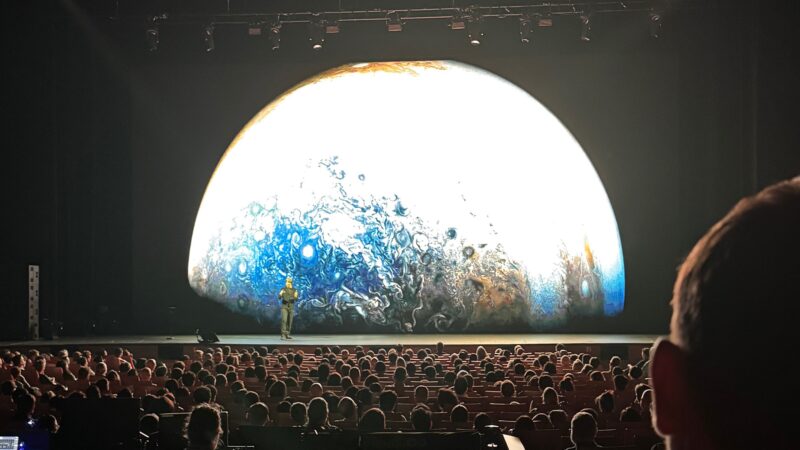
Recently I attended a lecture in Singapore by Professor Brian Cox: Emergence, his brand new world tour for 2026. Lots of really nice scientific theories explained in visually arresting ways and in such simple terms. It then inspired me to put down some of my own thoughts in this area. So here goes…

We usually think of time as a universal clock ticking away at the exact same speed for everyone. In reality, time is personal and elastic. It is a dimension just like up/down, left/right, and forward/backward that allows events to happen in a sequence. The mind-bending thing is that it passes at different rates depending on how fast you are moving and how much gravity is pulling on you.

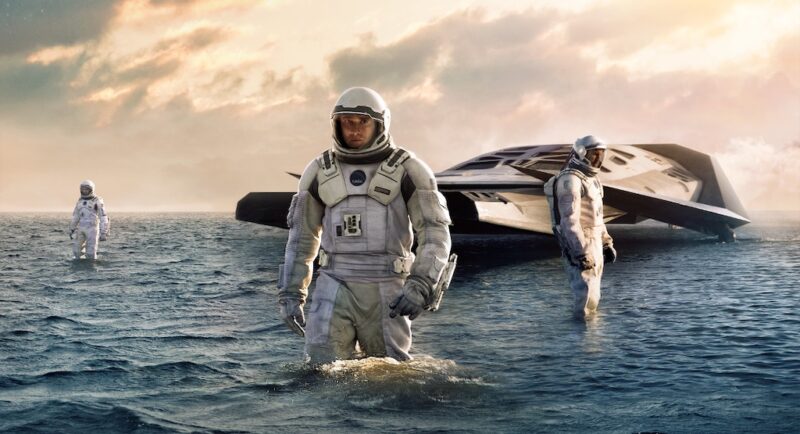
Miller’s Planet in Interstellar

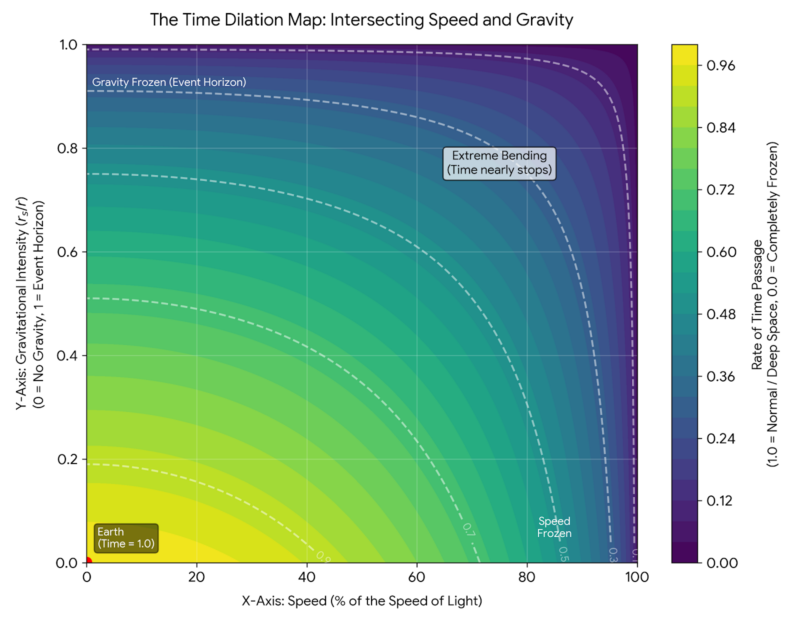
Remenber that Miller’s Planet scene in Interstellar? A few hours passed on the planet for the team that went down to the planet, but years for the space craft orbiting it. Then I though to myself is there a way to visualise how speed and gravity affects time in one chart. Of course with the help of AI, this chart is easily generated and thats what I did this weekend and its beautiful.

Two concepts we first need to understand.

  • Special Relativity – Einstein’s first big breakthrough was realizing that the speed of light is the absolute speed limit of the universe, and it never changes. Because the speed of light is constant, space and time have to bend to accommodate it. So if you travel on a spaceship near the speed of light, time actually slows down for you compared to someone standing still on Earth. This is time dilation.
  • General Relativity – A few years later, Einstein realized that space and time are stitched together into a single fabric called spacetime. Gravity isn’t a mysterious invisible pulling force; it’s the result of heavy objects bending that fabric. Imagine putting a heavy bowling ball on a trampoline. It creates a dip. If you roll a marble nearby, it spirals toward the bowling ball. That “dip” is gravity. Earth’s gravity curves the spacetime around it, which is what keeps our feet on the ground.

So putting these 2 concepts together, I generated this Time Dilation Map which shows how Speed and Gravity together affects time.

The Time Dilation Map - Intersecting Speed and Gravity

How to Read This Map:

  • The Color Scale (Z-Axis): The colors indicate the Rate of Time Passage.
    • Bright yellow areas “1” mean time is ticking at its normal, maximum speed.
    • Deep purple/blue areas “0” mean time has completely stopped relative to the rest of the universe.
  • The White Dashed Contour Lines: These act like elevation lines on a map, showing you exactly where time slows down to 90%, 70%, 50%, 30% and 10% of its normal rate.

The 4 Corners of the Universe on this Chart:

  1. The Bottom-Left Corner (Earth / Normal Life): This is where humans live. Our speed is practically 0% of the speed of light, and Earth’s gravity is incredibly weak compared to a black hole. Time here passes at a perfect “1” where we experience normal life. (While we know our solar system is zipping through space so we are not totally at no speed, but let’s keep it simple for now.)
  2. The Bottom-Right Corner (The Speed Zone): If you travel at 99% the speed of light out in empty space (far away from any stars or gravity), you drag your position horizontally all the way to the right. As you can see, the color plummets into the dark purple zone. Time almost freezes because of your velocity.
  3. The Top-Left Corner (The Gravity Zone): If you park your spaceship completely still, but right at the Event Horizon of a black hole “1” on the Y-axis, you move straight up the chart. Time freezes here entirely as well because of the immense gravity warping spacetime.
  4. The Top-Right Corner (The Ultimate Extreme): This is the realm where a traveler is both moving near the speed of light and falling into a black hole. Here, both variables compound to crush the passage of time down to absolute zero well before you even hit the maximum edge.

By treating speed and gravity as coordinates, an advanced interstellar traveler could use this exact map to calculate exactly how much they want to step into the future of the universe!

In fact, we have to calculate both of these variables right now for our GPS satellites! Because they are moving fast around the Earth, their clocks slow down. But because they are further away from Earth’s gravity, their clocks speed up. Scientists have to constantly correct for both variables, or your phone’s GPS would drift by miles every single day.

Very interesting things to think about.

The Studio: Changing from a Consumer to Creator Lifestyle

End of last year, as a family we did a year end review and also talked about what we individually want to do more in 2026. The thing I mentioned is I would like to create more and consume less and my dear Cleo have been keeping me in check. But it’s not easy and I ask myself why. I think how our lives happen at home is really due to the kind of rooms we have.

If you look at a typical home today especially in Singapore, it’s almost entirely built for consumption and recovery. We have the bedroom to recharge, the kitchen and dining room to fuel up, and the living room to consume content and host friends (which is my favourite part). We’ve become experts at  consumption and couch potato-ing honestly.

But there’s a missing piece in our daily rhythm: Creation.

We’ve treated our hobbies like extra things, clutter that needs to be tucked away in a cupboard. By not giving making a permanent space at home, we’re essentially telling our brains that creating is a secondary activity and not prioritized value.

I believe every home needs a Studio and here’s why:

The Problem with “The Dining Table”

Most of us have a hobby we love. Maybe you like sewing, painting, fixing electronics, pottery or something simpler like fixing a large jigsaw puzzle or Lego set. But because we don’t have a specific room for these things, we usually end up working on the dining room table.

This creates a “setup struggle.” You spend 15 minutes getting your stuff out, work for a little bit, and then have to pack everything away because it’s time for dinner. Eventually, you just stop making things because the effort of cleaning up isn’t worth it.

A studio changes this. It offers “permanent projects.” You can leave a half-finished painting on the easel or a sewing project on the desk, walk away, and come back to it whenever you have five minutes of free time.

From “Buying” to “Building” and from “Consuming” to “Creating”.

When a home has a studio, the family mindset shifts. Instead of thinking, “Where can I buy [whatever you need]?” or “Who can I hire to fix this?” you start thinking, “Can we make or fix that?”

  • Kids learn by watching: They see you solving problems with your hands and they learn that they too should try when faced with a challenge.
  • Skills become hobbies: You move from being a “customer” to being a “creator.”
  • Value is created: You aren’t just spending money on entertainment; you are creating something, a bowl, a dress, or a piece of art that didn’t exist before and something that expresses who you are.

A New Kind of Family Time

In the living room, everyone usually stares at the same screen in silence. In a studio, something different happens.

One person might be sketching at a desk while another is 3D-printing a part, knitting a scarf or a shared project whatever it might be. You are together, but you are all focused on your own “flow.” This is a deeper, more satisfying way to spend time as a family than just sitting on the couch and watching TV on the many streaming services which have been made so effortlessly accessible.

Making it Happen

A studio doesn’t have to be a giant, expensive workshop. It can be a converted spare bedroom, a corner of your house, or even a very organized walk-in closet. The only requirement is that it is a place dedicated to making things.

If we have a room for everything else we do in life, we should definitely have a room for the things we create.

So what is your next project if you have the space at home?

Brands surfing trends? or shaping the future?

Photo by Lucrezia Carnelos on Unsplash

I need to get this out of my system… so bear with me…

“Customer Centricity”. I’m honestly quite tired of hearing this. Maybe because I believe humans are irrational. Maybe because I think we as consumers don’t know what’s best for ourselves.

The consumer landscape is a dynamic, ever-shifting mosaic of desires, ethical demands, and technological expectations. Every brand, whether a global titan or an agile startup, stands at a critical strategic crossroads: should brands constantly respond to what consumers currently want, or should brands boldly endeavour to shape the future they believe in, leading consumers towards it?

This isn’t merely a business strategy question; it’s a fundamental choice that will determine not just market share, but potentially, the very trajectory of our collective “better future” as a human race.

Let’s explore this divide as it’s been on my mind a lot of late while responding to proposals or developing strategies to drive growth for brands.

The Responsive Brand: Mastering the Art of the Present

Many brands are experts at navigating the here and now. They are the astute surfers of consumer waves, their well invested R&D and innovation teams have finely tuned sensors, detecting every ripple from the surging demand for sustainable packaging and hyper-personalisation, to the integration of AI into daily life. Their market intelligence is impeccable, their agility unmatched.

Their strength lies in immediate relevance and reduced risk. They deliver what consumers are explicitly asking for, minimising speculation, recommendations backed by empirical data. We see this in the rapid proliferation of plant-based or organic options in every grocery store, the explosion of niche products and services in respond to the niche segment of needs and wants, algorithmic recommendations while you doom-scroll that maximise profit margins, the constant software updates that addresses the latest privacy concerns or introduction of generative AI features in every daily app even needed or not. They optimise existing paradigms, making them smoother, more efficient, and more palatable for the current consumer.

But here’s the critical question: does expertly reacting to current desires truly build a better future, or does it merely perpetuate and refine the existing one? While essential for market health and meeting immediate needs, this approach leads to incremental improvements rather than transformative leaps. It risks being derivative, focused on short-term gains, and potentially missing the deeper, unspoken societal needs that lie beneath the surface of popular culture. Worse, it drives our human race into ground, unhealthy, unmotivated, easily manipulated like sheep being lead to the slaughter.

The Visionary Brand: Building Tomorrow, Today

Then there are brands driven by a deep conviction, an almost prophetic perspective on how the world should be. These organisations aren’t just listening to consumers; they’re trying to educate them, inspire them, and ultimately, change their behaviour to align with a preferred future.

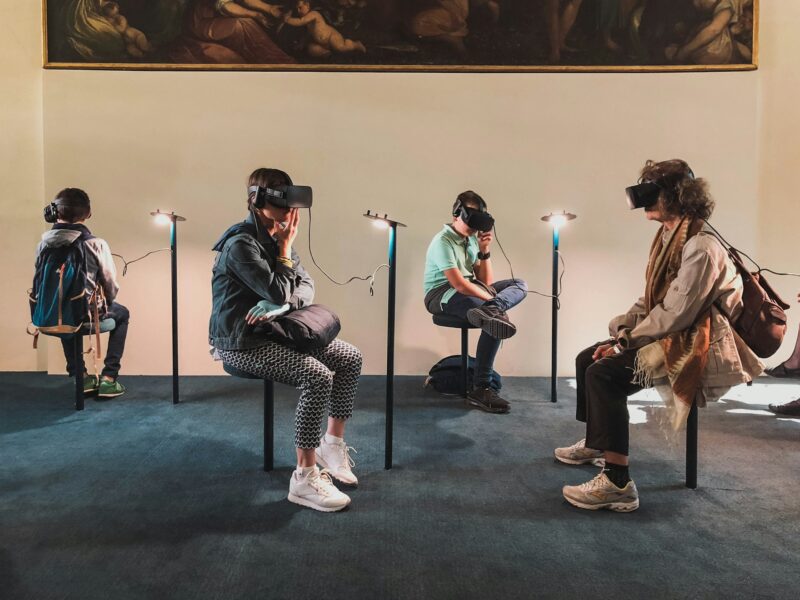
Think of the pioneers of electric vehicles, long before climate change was a mainstream concern for every household. Or companies investing in lab-grown meats or alternative source of proteins when the market was barely a whisper. Consider brands developing immersive virtual and augmented realities, not just as entertainment, but as platforms for entirely new forms of work, education, and social connection. Their products and services are often conceived not from a focus group, but from a profound belief in what’s possible and necessary.

Their strength lies in disruption, innovation, and long-term impact. They are willing to take significant risks, invest heavily in R&D, and embark on extensive educational campaigns to bring consumers along on their journey. They create new markets, establish new norms, and often, their initial offerings are met with skepticism before becoming the gold standard. When successful, these visionary brands don’t just participate in the future; they define it, often leading to profound societal benefits, from environmental sustainability to health advancements.

Think Patagonia (sustainability), think Tesla (energy & transportation), think Impossible Foods (ending the era of animal-based agriculture)…

However, this path is fraught with challenges: immense capital investment, significant consumer inertia, the risk of misjudging the future, and the long, arduous process of shifting ingrained habits.

Towards a Truly Better Tomorrow: A Call to Action

This distinction isn’t about declaring one approach inherently superior. Both play crucial roles. Responsive brands ensure that our journey is comfortable and that visionary breakthroughs are integrated seamlessly. Visionary brands, however, are the cartographers of new territories, daring to imagine and build paths we didn’t even know we needed.

The real challenge for us, as business leaders, innovators, and consumers, is to discern: Which brands are truly advancing the needle towards a better tomorrow?

  • Is a “better future” simply one where our current desires are perfectly met and seamlessly optimised? Or is it one where fundamental challenges, climate change, inequality, resource scarcity, digital well-being are confronted head-on by audacious visions?
  • Do we, as consumers, inadvertently empower brands that merely give us more of what we already consume, or do we reward those that challenge us to think differently, act differently, and aspire to a more sustainable, equitable, and fulfilling existence?
  • How can we, as a business community, foster an environment where bold, future-shaping convictions are not only celebrated but economically viable, even when they push us out of our comfort zones?

Perhaps the most potent combination for a truly better future lies in synergy… visionary brands daring to dream and build, coupled with responsive brands rapidly integrating and democratising those innovations once their path is proven. This interplay creates a dynamic tension that can drive genuine, sustainable progress.

Let’s open the conversation:

What role do you believe brands should play in shaping our future? Are we, as consumers, too focused on immediate gratification to truly support the long-term visionaries? And ultimately, how do we encourage more brands to not just react to the tide, but to help steer our Human race towards a truly better tomorrow?


Oh man… how I wish I can work on more Visionary Brands.

#Branding #Innovation #ConsumerTrends #Leadership #Strategy #Sustainability #Marketing #BusinessStrategy #FutureBuilding #VisionaryLeadership #ConsumerBehavior