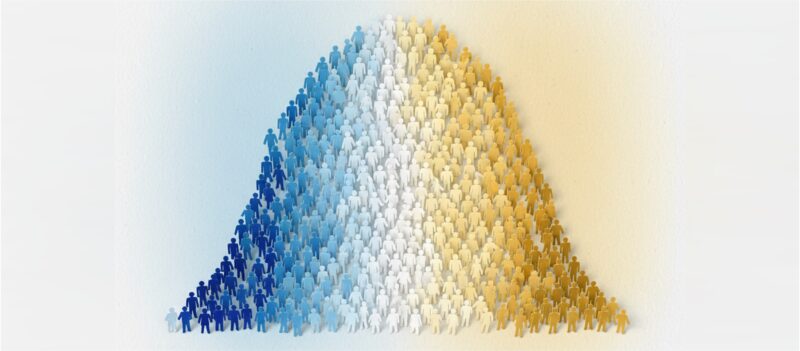
You know… sometimes I find myself observing people, and a thought keeps circling in my mind – a bit like how we all fit somewhere on a “spectrum”. Not just any spectrum, but what I like to call the “Human Bell Curve.” It’s a bit of a weird way to look at things, but thats just how my mind works, so pls bear with me.
On one far end, we have those truly angelic souls, the ones who are so genuinely good, kind, and generous that they almost shimmer. Selfless, always putting others first. The kind of people you just feel better being around. And then, at the other extreme, you find the truly self-centered, mean, and, dare I say, terrible individuals. The ones who drain your energy and make you wonder about humanity. I’m sure you can bucket a few people you know into one of these 2 category.
We often imagine these extremes are rare, just a handful of saints and a few devils. But what if we applied the statistical elegance of a bell curve to human nature? What if we truly understood where most of us land on this curve, and what that implies for our daily interactions? It’s a perspective shift that could genuinely change how we see the faces passing us by.
Let’s be honest, statistically speaking, most of us are probably right smack in the middle. Not Mother Teresa, not a supervillain, just… us. If that’s the case, think about it: there are roughly 50% of people “nicer” than us, and – a slightly more sobering thought – 50% who are “more challenging” or “less nice” than us. It means there’s a significant chunk of folks out there we need to learn to navigate with patience and grace. And for those wonderful souls on the nicer side? We really should be more actively thankful, shouldn’t we? A little appreciation goes a long way.
Now, imagine you’re one of the truly kind ones, perhaps in the upper echelons of this curve, with 80% of the population being “less nice” than you. That’s a lot of people! But here’s the beautiful paradox: because you possess that inherent kindness and empathy, you’re more likely to understand why people behave the way they do. You might see their struggles, their insecurities, their pain, and find it in your heart to forgive, to extend grace rather than judgment. It’s a silent superpower, that empathy.
And what about those at the other end, perhaps 80% are “nicer” than them? Well, if you’re operating from a place of meanness or selfishness, the concept of a bell curve probably doesn’t even cross your mind. You’re simply doing what you want, when you want, without much thought for the ripple effects. The lack of empathy means a lack of caring about where you stand or how others perceive you.
This isn’t about making a grand statement or pointing fingers. It’s just an observation, a lens through which to view the beautiful, messy tapestry of human interaction. It’s about cultivating an understanding and an awareness of where we, and others, might sit on this grand curve. And perhaps, just perhaps, this awareness helps us understand ourselves a little better, and gently guides us towards how we might choose to be in the world.
For the empathetic heart, this bell curve isn’t just a statistical model, but a whisper of potential. While the math might tell us where we are, I’m not one to let numbers fully dictate how life will turn out. Maybe, just maybe, if we each lean a little more into kindness, into generosity, we can collectively nudge that curve. We can all be part of a gentle, hopeful shift, moving the whole of humanity just a little bit further towards the good side. What if we all tried…